• Steven Ponce
  • About
  • Data Visualizations
  • Projects
  • Resume
  • Email

On this page

  • Challenge
  • Visualization
  • Steps to Create this Graphic
    • 1. Load Packages & Setup
    • 2. Read in the Data
    • 3. Examine the Data
    • 4. Tidy Data
    • 5. Visualization Parameters
    • 6. Plot
    • 7. Save
    • 8. Session Info
    • 9. GitHub Repository
    • 10. References
    • 11. Custom Functions Documentation

Summer delays arrive right on schedule

  • Show All Code
  • Hide All Code

  • View Source

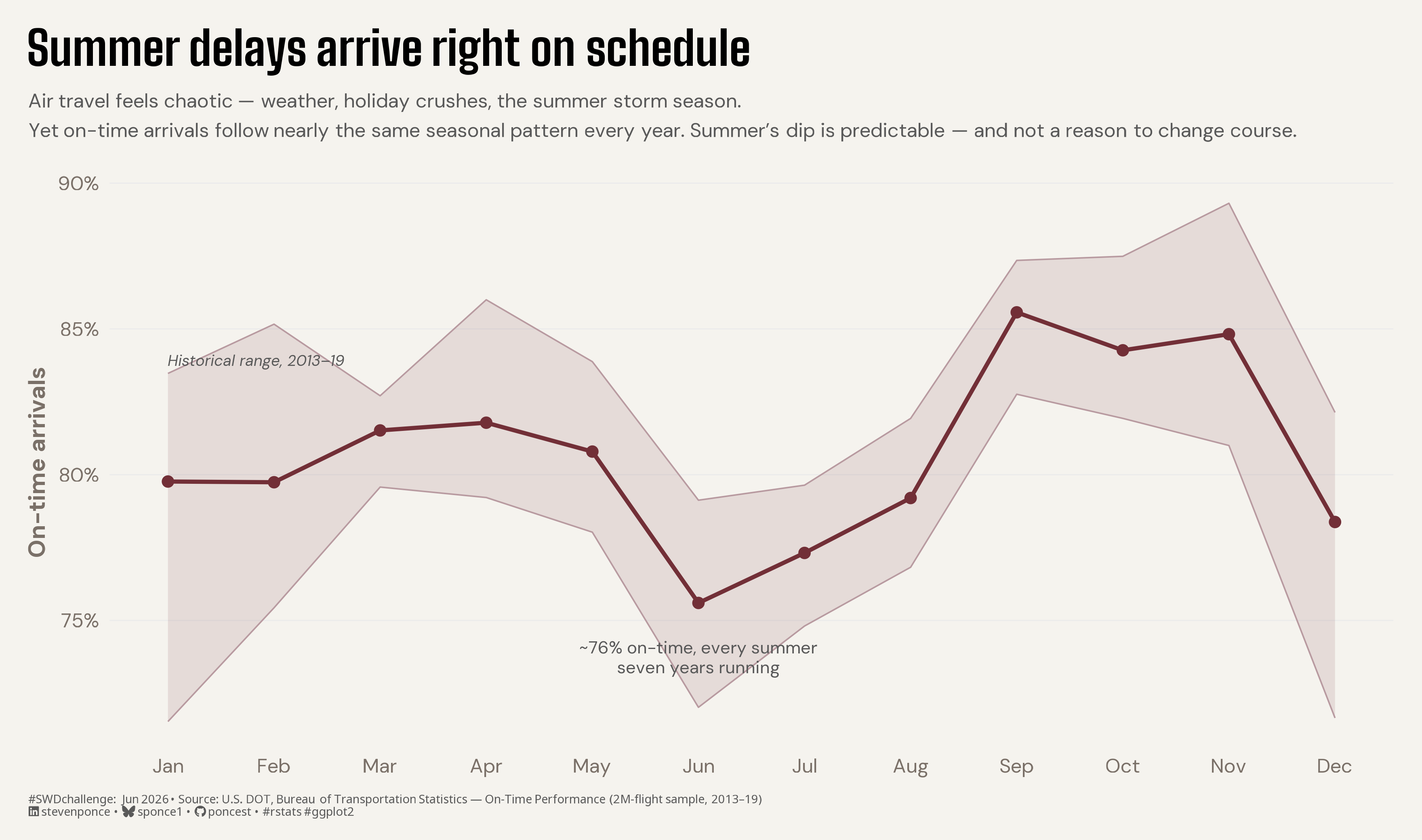
Air travel feels chaotic — weather, holiday crushes, the summer storm season. Yet on-time arrivals follow nearly the same seasonal pattern every year. Summer’s dip is predictable — and not a reason to change course.

SWDchallenge
Data Visualization
R Programming
2026
U.S. airline on-time arrivals trace nearly the same seasonal path every year, so the summer dip reads as expected rather than alarming. A typical-year line (the 2013–2019 average) sits inside a band of the full historical range, framing the variation as containment, not a target to beat. Built in R with ggplot2, ggtext, and camcorder.
Author

Steven Ponce

Published

June 1, 2026

Challenge

Some stories are meaningful because of what hasn’t changed. This month, we challenge you to design a view in which the most important takeaway is that things are performing as expected and the best decision is to stay the course. Think beyond a general metrics update and focus on situations where highlighting what’s expected helps to inform a specific action.

Additional information can be found HERE

Visualization

Figure 1: U.S. airline on-time performance follows a nearly identical seasonal rhythm each year, so the summer dip is expected rather than a warning sign. This line chart shows the typical year — the 2013–2019 monthly average — in burgundy: on-time arrivals sit near 80% in winter, dip to about 76% in June, climb to a peak near 86% in September, then fall back through December. A shaded band marks the full range across all seven years; the typical line stays inside it every month, and the band is narrowest in summer — meaning the worst month is also the most consistent. The y-axis runs from 75% to 90% on-time; the x-axis spans January through December.

Steps to Create this Graphic

1. Load Packages & Setup

Show code
```{r}
#| label: load

if (!require("pacman")) install.packages("pacman")
pacman::p_load(
  tidyverse, ggtext, showtext, janitor, scales, glue 
)

### |- figure size ---- 
camcorder::gg_record(
  dir    = here::here("temp_plots"),
  device = "png",
  width  = 11,
  height = 6.5,
  units  = "in",
  dpi    = 320
)

# Source utility functions
suppressMessages(source(here::here("R/utils/fonts.R")))
source(here::here("R/utils/social_icons.R"))
source(here::here("R/utils/image_utils.R"))
source(here::here("R/themes/base_theme.R"))
```

2. Read in the Data

Show code
```{r}
#| label: read

raw_data <- read_csv(
  here::here("data/SWDchallenge/2026/airline_2m.csv"),
  show_col_types = FALSE
) |> clean_names()
```

3. Examine the Data

Show code
```{r}
#| label: examine
#| include: true
#| eval: true
#| results: 'hide'
#| warning: false

glimpse(raw_data)
```

4. Tidy Data

Show code
```{r}
#| label: tidy
#| output: false

monthly <- raw_data |>
  filter(year >= 2013, year <= 2019) |>
  transmute(year, month, operated = cancelled == 0, on_time = arr_del15 == 0) |>
  summarise(ontime_rate = mean(on_time[operated], na.rm = TRUE), .by = c(year, month)) |>
  arrange(year, month)

band_all <- monthly |> summarise(lo = min(ontime_rate), hi = max(ontime_rate), .by = month)
avg_path <- monthly |> summarise(ontime_rate = mean(ontime_rate), .by = month)

### |-  anchor coordinates ----
jun_y <- avg_path$ontime_rate[avg_path$month == 6]
```

5. Visualization Parameters

Show code
```{r}
#| label: params

### |-  plot aesthetics ----
clrs <- get_theme_colors(
  palette = list(
    band = "#722F37", 
    edge = "#B89AA0", 
    line = "#722F37",
    anno = "gray35", 
    sub = "gray35"
  )
)

col_band <- clrs$palette$band
col_edge <- clrs$palette$edge
col_line <- clrs$palette$line
col_anno <- clrs$palette$anno
col_sub  <- clrs$palette$sub

### |- titles and caption ----
title_text <- "Summer delays arrive right on schedule"

subtitle_text <- glue(
  "Air travel feels chaotic \u2014 weather, holiday crushes, the summer storm season.<br>",
  "Yet on-time arrivals follow nearly the same seasonal pattern every year. ",
  "Summer's dip is predictable \u2014 and not a reason to change course."
)

caption_text <- create_swd_caption(
  year = 2026, month = "Jun",
  source_text = "U.S. DOT, Bureau of Transportation Statistics \u2014 On-Time Performance (2M-flight sample, 2013\u201319)"
)

### |-  fonts ----
setup_fonts()
fonts <- get_font_families()

### |-  plot theme ----
base_theme <- create_base_theme(clrs)

weekly_theme <- extend_weekly_theme(
  base_theme,
  theme(
    panel.grid.minor = element_blank(),
    panel.grid.major.x = element_blank(),
    panel.grid.major.y = element_line(color = "gray92", linewidth = 0.3),
    axis.ticks = element_blank(),
    plot.title.position = "plot",
    plot.caption = element_markdown(hjust = 0)
  )
)

theme_set(weekly_theme)
```

6. Plot

Show code
```{r}
#| label: plot
#| output: false

### |- main plot ----
p <- ggplot() +
  # Geoms
  geom_ribbon(
    data = band_all, aes(month, ymin = lo, ymax = hi),
    fill = col_band, alpha = 0.12
  ) +
  geom_line(data = band_all, aes(month, lo), color = col_edge, linewidth = 0.4) +
  geom_line(data = band_all, aes(month, hi), color = col_edge, linewidth = 0.4) +
  geom_line(data = avg_path, aes(month, ontime_rate), color = col_line, linewidth = 1.1) +
  geom_point(data = avg_path, aes(month, ontime_rate), color = col_line, size = 2.4) +
  # Annotate
  annotate("text",
    x = 6, y = jun_y, vjust = 2.2, hjust = 0.5,
    family = fonts$text, size = 3.4, lineheight = 0.95, color = col_anno,
    label = "~76% on-time, every summer\nseven years running"
  ) +
  annotate("text",
    x = 1, y = band_all$hi[band_all$month == 1], hjust = 0, vjust = -0.7,
    family = fonts$text, size = 3, fontface = "italic", color = col_anno,
    label = "Historical range, 2013\u201319"
  ) +
  # Scales
  scale_x_continuous(breaks = 1:12, labels = month.abb) +
  scale_y_continuous(labels = label_percent(accuracy = 1)) +
  # Labs
  labs(
    title = title_text, subtitle = subtitle_text,
    x = NULL, y = "On-time arrivals", caption = caption_text
  ) +
  coord_cartesian(clip = "off") +
  # Theme
  theme(
    plot.title = element_markdown(
      size = 26, face = "bold", family = fonts$title_1,
      color = clrs$palette$title, margin = margin(b = 10), lineheight = 1.2
    ),
    plot.subtitle = element_textbox_simple(
      size = 11, family = fonts$text, color = col_sub,
      lineheight = 1.5, margin = margin(b = 20)
    ),
    plot.caption = element_markdown(
      size = 6.5, family = fonts$caption, color = col_sub,
      hjust = 0, margin = margin(t = 10)
    ),
    plot.background = element_rect(fill = clrs$palette$bg, color = NA),
    plot.margin = margin(16, 16, 12, 16)
  )
```

7. Save

Show code
```{r}
#| label: save

### |-  plot image ----  
save_plot(
  p, 
  type = 'swd', 
  year = 2026, 
  month = 06, 
  width  = 11,
  height = 6.5,
  )
```

8. Session Info

TipExpand for Session Info
R version 4.5.3 (2026-03-11 ucrt)
Platform: x86_64-w64-mingw32/x64
Running under: Windows 11 x64 (build 26100)

Matrix products: default
  LAPACK version 3.12.1

locale:
[1] LC_COLLATE=English_United States.utf8 
[2] LC_CTYPE=English_United States.utf8   
[3] LC_MONETARY=English_United States.utf8
[4] LC_NUMERIC=C                          
[5] LC_TIME=English_United States.utf8    

time zone: America/New_York
tzcode source: internal

attached base packages:
[1] stats     graphics  grDevices utils     datasets  methods   base     

other attached packages:
 [1] here_1.0.2      glue_1.8.0      scales_1.4.0    janitor_2.2.1  
 [5] showtext_0.9-8  showtextdb_3.0  sysfonts_0.8.9  ggtext_0.1.2   
 [9] lubridate_1.9.5 forcats_1.0.1   stringr_1.6.0   dplyr_1.2.1    
[13] purrr_1.2.2     readr_2.2.0     tidyr_1.3.2     tibble_3.3.1   
[17] ggplot2_4.0.3   tidyverse_2.0.0 pacman_0.5.1   

loaded via a namespace (and not attached):
 [1] gtable_0.3.6       xfun_0.57          htmlwidgets_1.6.4  tzdb_0.5.0        
 [5] vctrs_0.7.3        tools_4.5.3        generics_0.1.4     curl_7.0.0        
 [9] parallel_4.5.3     gifski_1.32.0-2    pkgconfig_2.0.3    RColorBrewer_1.1-3
[13] S7_0.2.1           lifecycle_1.0.5    compiler_4.5.3     farver_2.1.2      
[17] textshaping_1.0.5  codetools_0.2-20   snakecase_0.11.1   litedown_0.9      
[21] htmltools_0.5.9    yaml_2.3.12        pillar_1.11.1      crayon_1.5.3      
[25] camcorder_0.1.0    magick_2.9.1       commonmark_2.0.0   tidyselect_1.2.1  
[29] digest_0.6.39      stringi_1.8.7      labeling_0.4.3     rsvg_2.7.0        
[33] rprojroot_2.1.1    fastmap_1.2.0      grid_4.5.3         cli_3.6.6         
[37] magrittr_2.0.5     withr_3.0.2        bit64_4.6.0-1      timechange_0.4.0  
[41] rmarkdown_2.31     bit_4.6.0          otel_0.2.0         ragg_1.5.2        
[45] hms_1.1.4          evaluate_1.0.5     knitr_1.51         markdown_2.0      
[49] rlang_1.2.0        gridtext_0.1.6     Rcpp_1.1.1         xml2_1.5.2        
[53] svglite_2.2.2      rstudioapi_0.18.0  vroom_1.7.1        jsonlite_2.0.0    
[57] R6_2.6.1           systemfonts_1.3.2 

9. GitHub Repository

TipExpand for GitHub Repo

The complete code for this analysis is available in swd_2026_06.qmd. For the full repository, click here.

10. References

TipExpand for References

SWD Challenge:

  • Storytelling with Data: June 2026 — when normal is noteworthy

Data Sources:

  • Bureau of Transportation Statistics. Reporting Carrier On-Time Performance. U.S. Department of Transportation. https://www.transtats.bts.gov/
  • mexwell. Carrier On-Time Performance Dataset. Kaggle. https://www.kaggle.com/datasets/mexwell/carrier-on-time-performance-dataset — a ~2M-flight random sample of the BTS data; full years 2013–2019 analyzed.

Background References:

  • U.S. Department of Transportation. Air Travel Consumer Report. https://www.transportation.gov/airconsumer — national on-time arrival rate, ~79–80% across 2013–2019 (79.0% for full-year 2019), used as the reference average.

Book Reference:

  • Knaflic, C. N. (2015). Storytelling with Data: A Data Visualization Guide for Business Professionals. Wiley.

11. Custom Functions Documentation

Note📦 Custom Helper Functions

This analysis uses custom functions from my personal module library for efficiency and consistency across projects.

Functions Used:

  • fonts.R: setup_fonts(), get_font_families() - Font management with showtext
  • social_icons.R: create_social_caption() - Generates formatted social media captions
  • image_utils.R: save_plot() - Consistent plot saving with naming conventions
  • base_theme.R: create_base_theme(), extend_weekly_theme(), get_theme_colors() - Custom ggplot2 themes

Why custom functions?
These utilities standardize theming, fonts, and output across all my data visualizations. The core analysis (data tidying and visualization logic) uses only standard tidyverse packages.

Source Code:
View all custom functions → GitHub: R/utils

Back to top

Citation

BibTeX citation:
@online{ponce2026,
  author = {Ponce, Steven},
  title = {Summer Delays Arrive Right on Schedule},
  date = {2026-06-01},
  url = {https://stevenponce.netlify.app/data_visualizations/SWD%20Challenge/2026/swd_2026_06.html},
  langid = {en}
}
For attribution, please cite this work as:
Ponce, Steven. 2026. “Summer Delays Arrive Right on Schedule.” June 1. https://stevenponce.netlify.app/data_visualizations/SWD%20Challenge/2026/swd_2026_06.html.
Source Code
---
title: "Summer delays arrive right on schedule"
subtitle: "Air travel feels chaotic — weather, holiday crushes, the summer storm season. Yet on-time arrivals follow nearly the same seasonal pattern every year. Summer's dip is predictable — and not a reason to change course."
description: "U.S. airline on-time arrivals trace nearly the same seasonal path every year, so the summer dip reads as expected rather than alarming. A typical-year line (the 2013–2019 average) sits inside a band of the full historical range, framing the variation as containment, not a target to beat. Built in R with ggplot2, ggtext, and camcorder."
date: "2026-06-01"
author:
  - name: "Steven Ponce"
    url: "https://stevenponce.netlify.app"
citation:
  url: "https://stevenponce.netlify.app/data_visualizations/SWD%20Challenge/2026/swd_2026_06.html"
categories: ["SWDchallenge", "Data Visualization", "R Programming", "2026"]
tags: [
  "swd-challenge",
  "line-chart",
  "range-band",
  "seasonality",
  "airlines",
  "on-time-performance",
  "containment",
  "stability",
  "annotation",
  "ggtext",
  "camcorder",
  "2026"
]
image: "thumbnails/swd_2026_06.png"
format:
  html:
    toc: true
    toc-depth: 5
    code-link: true
    code-fold: true
    code-tools: true
    code-summary: "Show code"
    self-contained: true
    theme: 
      light: [flatly, assets/styling/custom_styles.scss]
      dark: [darkly, assets/styling/custom_styles_dark.scss]
editor_options: 
  chunk_output_type: inline
execute: 
  freeze: true
  cache: true
  error: false
  message: false
  warning: false
  eval: true
---
### Challenge

Some stories are meaningful because of what hasn’t changed. This month, we challenge you to design a view in which the most important takeaway is that things are performing as expected and the best decision is to stay the course. Think beyond a general metrics update and focus on situations where highlighting what’s expected helps to inform a specific action.

Additional information can be found [HERE](https://community.storytellingwithdata.com/challenges)

### Visualization
![ U.S. airline on-time performance follows a nearly identical seasonal rhythm each year, so the summer dip is expected rather than a warning sign. This line chart shows the typical year — the 2013–2019 monthly average — in burgundy: on-time arrivals sit near 80% in winter, dip to about 76% in June, climb to a peak near 86% in September, then fall back through December. A shaded band marks the full range across all seven years; the typical line stays inside it every month, and the band is narrowest in summer — meaning the worst month is also the most consistent. The y-axis runs from 75% to 90% on-time; the x-axis spans January through December.](swd_2026_06.png){#fig-1}

### [**Steps to Create this Graphic**]{.mark}

#### [1. Load Packages & Setup]{.smallcaps}

```{r}
#| label: load

if (!require("pacman")) install.packages("pacman")
pacman::p_load(
  tidyverse, ggtext, showtext, janitor, scales, glue 
)

### |- figure size ---- 
camcorder::gg_record(
  dir    = here::here("temp_plots"),
  device = "png",
  width  = 11,
  height = 6.5,
  units  = "in",
  dpi    = 320
)

# Source utility functions
suppressMessages(source(here::here("R/utils/fonts.R")))
source(here::here("R/utils/social_icons.R"))
source(here::here("R/utils/image_utils.R"))
source(here::here("R/themes/base_theme.R"))
```

#### [2. Read in the Data]{.smallcaps}

```{r}
#| label: read

raw_data <- read_csv(
  here::here("data/SWDchallenge/2026/airline_2m.csv"),
  show_col_types = FALSE
) |> clean_names()
```

#### [3. Examine the Data]{.smallcaps}

```{r}
#| label: examine
#| include: true
#| eval: true
#| results: 'hide'
#| warning: false

glimpse(raw_data)
```

#### [4. Tidy Data]{.smallcaps}

```{r}
#| label: tidy
#| output: false

monthly <- raw_data |>
  filter(year >= 2013, year <= 2019) |>
  transmute(year, month, operated = cancelled == 0, on_time = arr_del15 == 0) |>
  summarise(ontime_rate = mean(on_time[operated], na.rm = TRUE), .by = c(year, month)) |>
  arrange(year, month)

band_all <- monthly |> summarise(lo = min(ontime_rate), hi = max(ontime_rate), .by = month)
avg_path <- monthly |> summarise(ontime_rate = mean(ontime_rate), .by = month)

### |-  anchor coordinates ----
jun_y <- avg_path$ontime_rate[avg_path$month == 6]

```

#### [5. Visualization Parameters]{.smallcaps}

```{r}
#| label: params

### |-  plot aesthetics ----
clrs <- get_theme_colors(
  palette = list(
    band = "#722F37", 
    edge = "#B89AA0", 
    line = "#722F37",
    anno = "gray35", 
    sub = "gray35"
  )
)

col_band <- clrs$palette$band
col_edge <- clrs$palette$edge
col_line <- clrs$palette$line
col_anno <- clrs$palette$anno
col_sub  <- clrs$palette$sub

### |- titles and caption ----
title_text <- "Summer delays arrive right on schedule"

subtitle_text <- glue(
  "Air travel feels chaotic \u2014 weather, holiday crushes, the summer storm season.<br>",
  "Yet on-time arrivals follow nearly the same seasonal pattern every year. ",
  "Summer's dip is predictable \u2014 and not a reason to change course."
)

caption_text <- create_swd_caption(
  year = 2026, month = "Jun",
  source_text = "U.S. DOT, Bureau of Transportation Statistics \u2014 On-Time Performance (2M-flight sample, 2013\u201319)"
)

### |-  fonts ----
setup_fonts()
fonts <- get_font_families()

### |-  plot theme ----
base_theme <- create_base_theme(clrs)

weekly_theme <- extend_weekly_theme(
  base_theme,
  theme(
    panel.grid.minor = element_blank(),
    panel.grid.major.x = element_blank(),
    panel.grid.major.y = element_line(color = "gray92", linewidth = 0.3),
    axis.ticks = element_blank(),
    plot.title.position = "plot",
    plot.caption = element_markdown(hjust = 0)
  )
)

theme_set(weekly_theme)
```

#### [6. Plot]{.smallcaps}

```{r}
#| label: plot
#| output: false

### |- main plot ----
p <- ggplot() +
  # Geoms
  geom_ribbon(
    data = band_all, aes(month, ymin = lo, ymax = hi),
    fill = col_band, alpha = 0.12
  ) +
  geom_line(data = band_all, aes(month, lo), color = col_edge, linewidth = 0.4) +
  geom_line(data = band_all, aes(month, hi), color = col_edge, linewidth = 0.4) +
  geom_line(data = avg_path, aes(month, ontime_rate), color = col_line, linewidth = 1.1) +
  geom_point(data = avg_path, aes(month, ontime_rate), color = col_line, size = 2.4) +
  # Annotate
  annotate("text",
    x = 6, y = jun_y, vjust = 2.2, hjust = 0.5,
    family = fonts$text, size = 3.4, lineheight = 0.95, color = col_anno,
    label = "~76% on-time, every summer\nseven years running"
  ) +
  annotate("text",
    x = 1, y = band_all$hi[band_all$month == 1], hjust = 0, vjust = -0.7,
    family = fonts$text, size = 3, fontface = "italic", color = col_anno,
    label = "Historical range, 2013\u201319"
  ) +
  # Scales
  scale_x_continuous(breaks = 1:12, labels = month.abb) +
  scale_y_continuous(labels = label_percent(accuracy = 1)) +
  # Labs
  labs(
    title = title_text, subtitle = subtitle_text,
    x = NULL, y = "On-time arrivals", caption = caption_text
  ) +
  coord_cartesian(clip = "off") +
  # Theme
  theme(
    plot.title = element_markdown(
      size = 26, face = "bold", family = fonts$title_1,
      color = clrs$palette$title, margin = margin(b = 10), lineheight = 1.2
    ),
    plot.subtitle = element_textbox_simple(
      size = 11, family = fonts$text, color = col_sub,
      lineheight = 1.5, margin = margin(b = 20)
    ),
    plot.caption = element_markdown(
      size = 6.5, family = fonts$caption, color = col_sub,
      hjust = 0, margin = margin(t = 10)
    ),
    plot.background = element_rect(fill = clrs$palette$bg, color = NA),
    plot.margin = margin(16, 16, 12, 16)
  )
```

#### [7. Save]{.smallcaps}

```{r}
#| label: save

### |-  plot image ----  
save_plot(
  p, 
  type = 'swd', 
  year = 2026, 
  month = 06, 
  width  = 11,
  height = 6.5,
  )
```

#### [8. Session Info]{.smallcaps}

::: {.callout-tip collapse="true"}
##### Expand for Session Info

```{r, echo = FALSE}
#| eval: true
#| warning: false

sessionInfo()
```
:::

#### [9. GitHub Repository]{.smallcaps}

::: {.callout-tip collapse="true"}
##### Expand for GitHub Repo

The complete code for this analysis is available in [`swd_2026_06.qmd`](https://github.com/poncest/personal-website/tree/master/data_visualizations/SWD%20Challenge/2026/swd_2026_06.qmd). For the full repository, [click here](https://github.com/poncest/personal-website/).
:::

#### [10. References]{.smallcaps}
::: {.callout-tip collapse="true"}
##### Expand for References

**SWD Challenge:**

- Storytelling with Data: [June 2026 — when normal is noteworthy](https://community.storytellingwithdata.com/challenges/jun-2026-when-normal-is-noteworthy)

**Data Sources:**

- Bureau of Transportation Statistics. *Reporting Carrier On-Time Performance*. U.S. Department of Transportation. <https://www.transtats.bts.gov/>
- mexwell. *Carrier On-Time Performance Dataset*. Kaggle. <https://www.kaggle.com/datasets/mexwell/carrier-on-time-performance-dataset> — a ~2M-flight random sample of the BTS data; full years 2013–2019 analyzed.

**Background References:**

- U.S. Department of Transportation. *Air Travel Consumer Report*. <https://www.transportation.gov/airconsumer> — national on-time arrival rate, ~79–80% across 2013–2019 (79.0% for full-year 2019), used as the reference average.

**Book Reference:**

- Knaflic, C. N. (2015). *Storytelling with Data: A Data Visualization Guide for Business Professionals*. Wiley.
:::


#### [11. Custom Functions Documentation]{.smallcaps}

::: {.callout-note collapse="true"}
##### 📦 Custom Helper Functions

This analysis uses custom functions from my personal module library for efficiency and consistency across projects.

**Functions Used:**

-   **`fonts.R`**: `setup_fonts()`, `get_font_families()` - Font management with showtext
-   **`social_icons.R`**: `create_social_caption()` - Generates formatted social media captions
-   **`image_utils.R`**: `save_plot()` - Consistent plot saving with naming conventions
-   **`base_theme.R`**: `create_base_theme()`, `extend_weekly_theme()`, `get_theme_colors()` - Custom ggplot2 themes

**Why custom functions?**\
These utilities standardize theming, fonts, and output across all my data visualizations. The core analysis (data tidying and visualization logic) uses only standard tidyverse packages.

**Source Code:**\
View all custom functions → [GitHub: R/utils](https://github.com/poncest/personal-website/tree/master/R)
:::

© 2024 Steven Ponce

Source Issues